
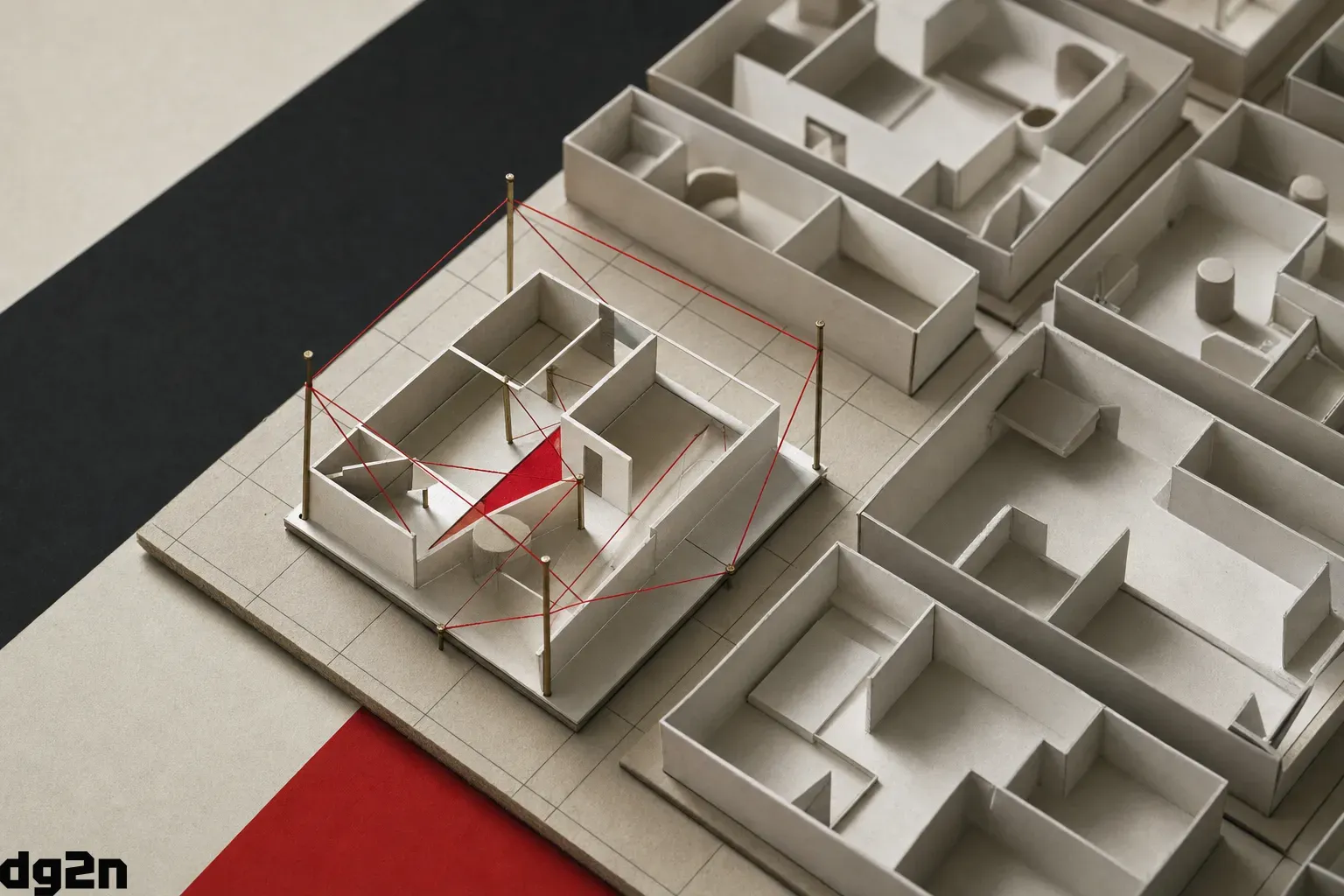
Design got cheap. Judgment didn't.
You can now ask a generative tool for two hundred floor plans before lunch. Every one of them will pass code, use the site efficiently and render well enough to win a pitch. So making the option is no longer the hard part. Knowing which one is any good is.
Machine learning has a name for that knowing: the loss function. It's the number that tells a model how wrong it was, so the next attempt can be a little less wrong. Take it away and the model doesn't learn anything. It just keeps generating.
Buildings don't have one. We have codes and standards, rules of thumb, juries, critics, and the client's gut. What we mostly don't have is measured evidence that one spatial decision leaves people better off than another. I trained as an architect, and these days I spend most of my time inside digital twins of retail stores. The gap between those two worlds is what this piece is about.
Architecture's evidence gap
Most buildings never get checked against what they were supposed to do. Post-occupancy evaluation has been around as a discipline since the 1950s, and it's still the exception. When the Architects' Journal surveyed the UK's biggest practices in 2020, only 4% said they always did one, and a quarter said they never did.1 Facilities managers like to quote a figure of under 5% of projects, though I'd treat that one as a rough guide.
I don't think this is because architects don't care. For a start, nobody pays for the follow-up. Our contracts end at handover. Then the developer sells to an owner, who leases to tenants, whose staff and customers are the people actually using the place. By the time anyone could measure the room, everyone who drew it has moved on to the next job.
And when a POE does happen, it's usually a survey. It tells you how people feel about this building. It almost never tells you what would have happened in a different one, and that gap between describing and explaining is the one that matters. Even healthcare, which took evidence-based design more seriously than anyone, runs into it. A 2024 study its authors called the first and largest randomized trial of hospital-room design randomized 558 people to look at virtual rooms online. None of them was a patient in any of those rooms. Putting real people into real buildings at random is close to impossible.
So we run on precedent, codes and taste. That was fine when every option was expensive to draw and a senior architect's judgment did the filtering. It stops being fine when a model can produce more options in an hour than a firm can review in a year.
The shop runs experiments every week
Retail is the strange exception. Stores get re-laid every season. Fixtures move on a Tuesday night, and the tills record what happens next. The operator also owns the outcome, so nobody has to be talked into paying for the measurement. Every reset is an experiment of sorts. Most are sloppy. A few aren't.
In England, researchers from Southampton and City St George's worked with the discount chain Iceland on a study called WRAPPED. Eighteen stores moved a bigger fruit and veg section up to the entrance, and eighteen matched stores left things as they were. The study ran from 2018 to 2022, with each store keeping the new layout for six months. Compared with what they'd have been expected to sell, the moved sections shifted roughly 2,525 extra portions per store per week, at a time when UK produce buying overall was falling.
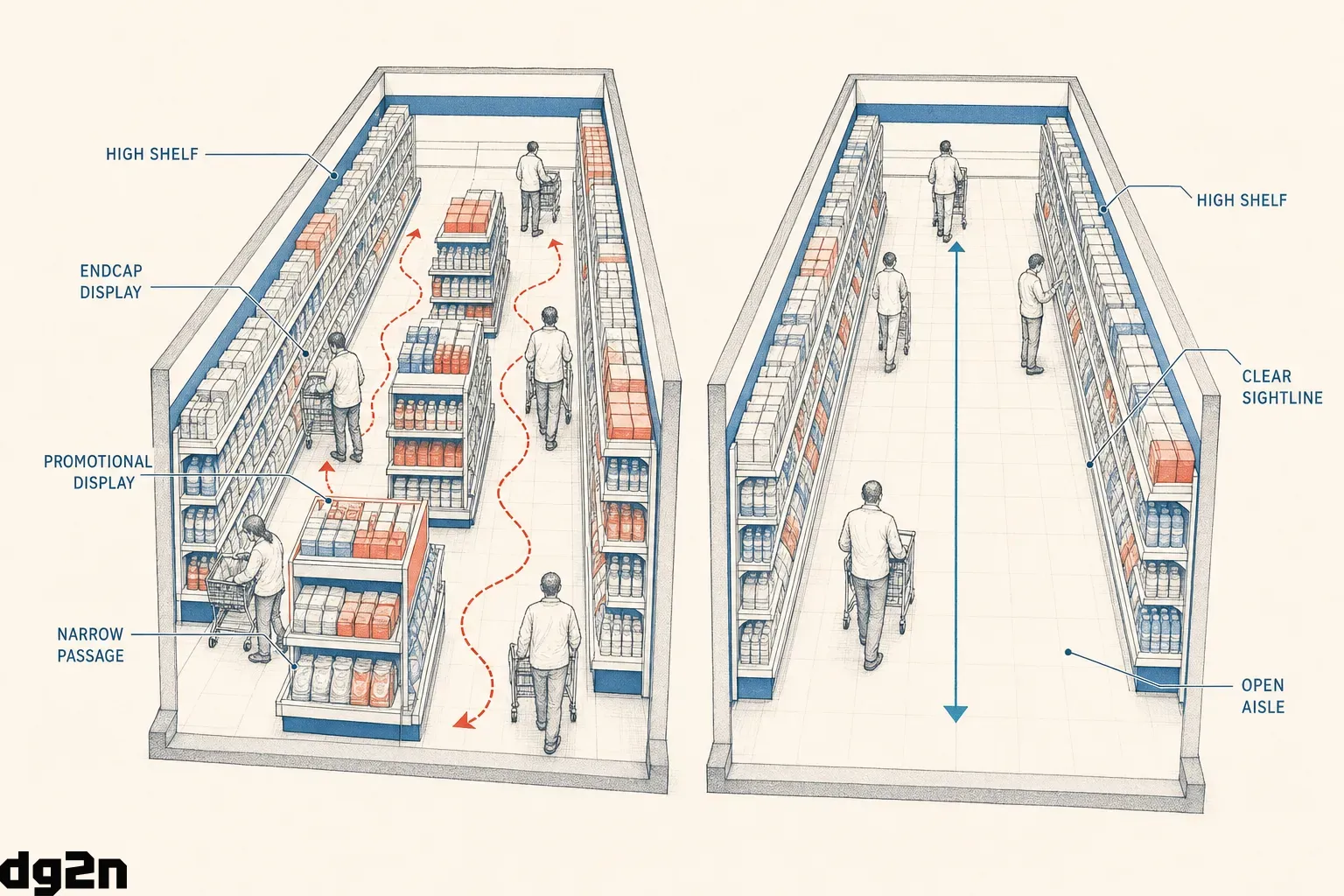
In Tyrol, Mathias Streicher at the University of Innsbruck tried something smaller and, I think, sharper. He took a single aisle in a single supermarket. For six weeks it had five display stands down the middle; for the next six it had none. The aisle's share of the store's revenue went from 4.33% to 4.83%, a jump of about 11.5%, even though there was less on show. Shoppers pushing carts stopped and picked things up about seven times as often once the floor was clear.
Neither study is airtight, and the authors say so. WRAPPED wasn't randomized, its sales boost was biggest early on and then faded, and it ran straight through Brexit, COVID and a cost-of-living crisis. Innsbruck is one aisle, before and after, and seasonality could be doing some of the work. Still, look at what they are. One compares a spatial decision across 36 buildings with controls. The other pins a number on a single variable, how much clear floor there is, in a live room. Most buildings never get that much causal evidence in their entire lives.
The Innsbruck result is really an architecture finding wearing a retail badge. Narrow passages make people feel less in control, and they engage less with what's around them. Replace "shelf" with "noticeboard" or "bookcase" and you're talking about school corridors and library stacks. Retail found it first because retail could afford to look.
Simulation isn't evidence
The obvious pushback: why wait for real stores when you can simulate shoppers? The tools are certainly coming. In South Korea, the company behind the CU convenience chain is reportedly building virtual store simulations to test displays, foot traffic and assortment before it touches a real shop. There are open-source sandboxes now where you can drop LLM-driven customers into a 3D floor plan and A/B test the circulation.
I'm genuinely excited about this. I'm also a bit suspicious of where the accuracy numbers come from. Most synthetic-consumer benchmarks check the agents against surveys, which tell you what people say, not what they do in a room. The most careful work I've read is Shopify's SimGym, and its authors are refreshingly straight about the limits. Earlier systems, they point out, showed that agents can behave like shoppers but not that they can predict how real shoppers react to a change. Their own agents, built from each shop's real traffic, got the direction of a change right in about 69% of 20 shops. A coin would get 50%.
That's real progress. Two things are worth noticing, though. It's all on web pages, where every click is already logged, and a physical aisle has no clickstream. And the only reason we know the number is 69% is that 20 real shops changed their design and somebody measured what real people did afterwards. Take that away and the simulator is just a confident guess.
Which is really my whole argument. A simulator is a model, and a model needs a loss function. For simulated shoppers in physical space, the loss is the gap between what the agents predicted and what actually happened in a real store after a real change. You can only measure that gap if the real store is recorded as carefully as the simulated one: same geometry, same fixtures, same paths, same outcomes, before and after.

That's what a store twin is for, and it's why I care about them. The nice 3D model is the least important part. What matters is the record underneath: every version of the room, and what people did in each one. Chains already change layouts across hundreds of near-identical stores. Capture those changes properly and every reset turns into a labeled example, which is exactly the kind of training signal architecture has never had.
Sales can't be the only number
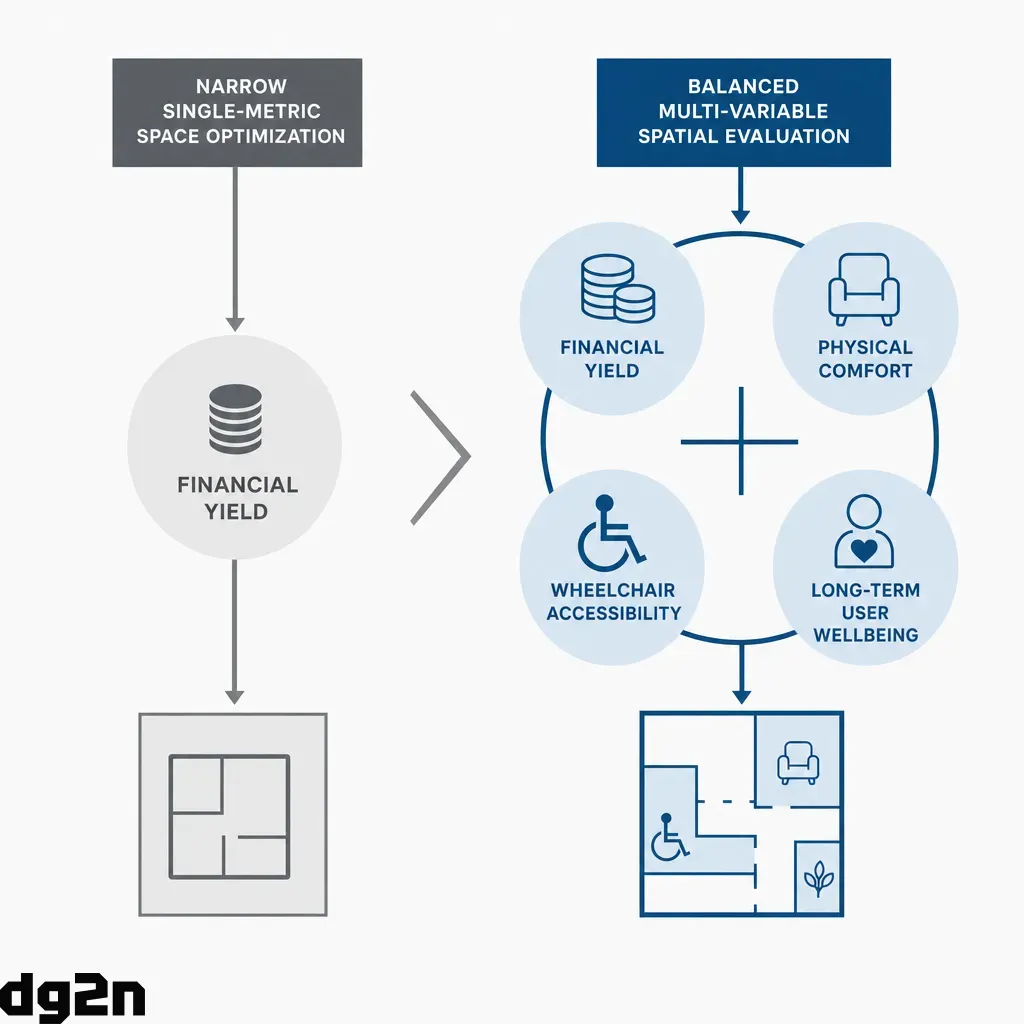
There's an obvious danger in all this. Give a generative system one number to chase and it'll chase it. If the only signal is revenue per square metre, we'll get rooms that are brilliant at revenue per square metre. Anyone who's been herded through an airport duty-free knows what that feels like.
The two retail studies already show the problem on a small scale. Mid-aisle stands earn the store slotting fees from brands, as Streicher himself points out, so a store chasing fee income would keep the very stands that cost it overall sales. WRAPPED's sales gains were biggest early and faded over time, so anything that scored layouts on week one would overrate them. The same study found households near the new layouts reporting more wasted fruit and veg at six months, and selling more produce isn't the same as people eating more of it. And in Innsbruck, the crowded aisle hurt cart users far more than people with baskets. Swap carts for wheelchairs, prams or walking frames and you can see how an average could hide exactly the people a designer should be protecting.
So whatever we use to score a space has to measure more than the till. It needs the commercial side, because someone pays for the building. It needs the human side too: health, comfort, whether people feel in control and can find their way. It should look at the worst-served group, not only the average. And it has to run long enough to catch the novelty wearing off and the costs turning up somewhere else.
None of that is free to measure. It's a lot cheaper, though, in a store that's already instrumented than in an office, a school or a hospital ward that isn't. That's why I think retail should go first. Shops don't matter more than schools; they're just the one place where the experiment is already running.
Build the loss function first
We're about to give designers an engine that never gets tired of producing options. What'll be scarce is the ability to say, with evidence, that this option is better than that one for the people who'll actually use it. Architecture doesn't have that today, and generating more won't give it to us.
Retail is the nearest thing we've got to a laboratory: buildings that change every week, operators who own the result, and a growing habit of measuring the room itself. Twin those stores properly, keep every version, measure more than sales, and you'd have the first real training signal for spatial design. The rest of architecture could borrow it from there.
I don't think the interesting question for my profession is whether AI can design a building. It's whether we'll ever find out if the building worked.
Footnotes
-
HLM Architects, The Importance of Post-Occupancy Evaluation in Architecture (2020-06-11) — secondary report. "Launched last week, the AJ100 survey revealed that post-occupancy performance evaluation is 'always' done by just 4 per cent of AJ100 practices, 'frequently' done by 22 per cent, while a quarter of firms never do so and around a half (48 per cent) only seek to evaluate the performance of their projects 'occasionally'." ↩