
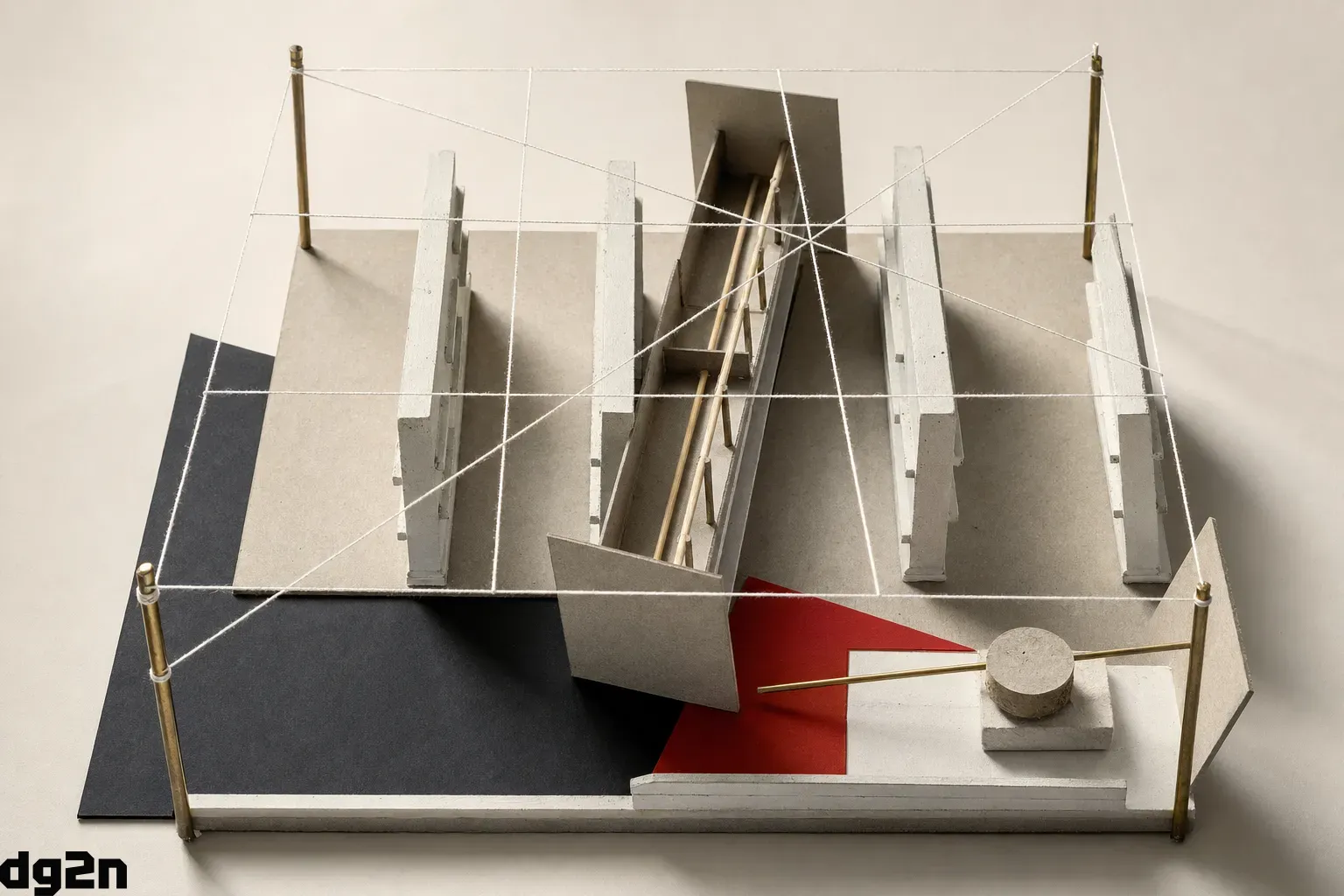
Two new kinds of shopper are learning your store, and neither has seen the floor plan. One walks a virtual copy of your layout before you build it. The other sits on a customer's face and describes your aisles to her as she walks them.
Both are useful. Both are guessing. And the thing that would stop them guessing, a measured, current model of the actual floor, is the asset most chains still do not have.
A model is already describing your aisles
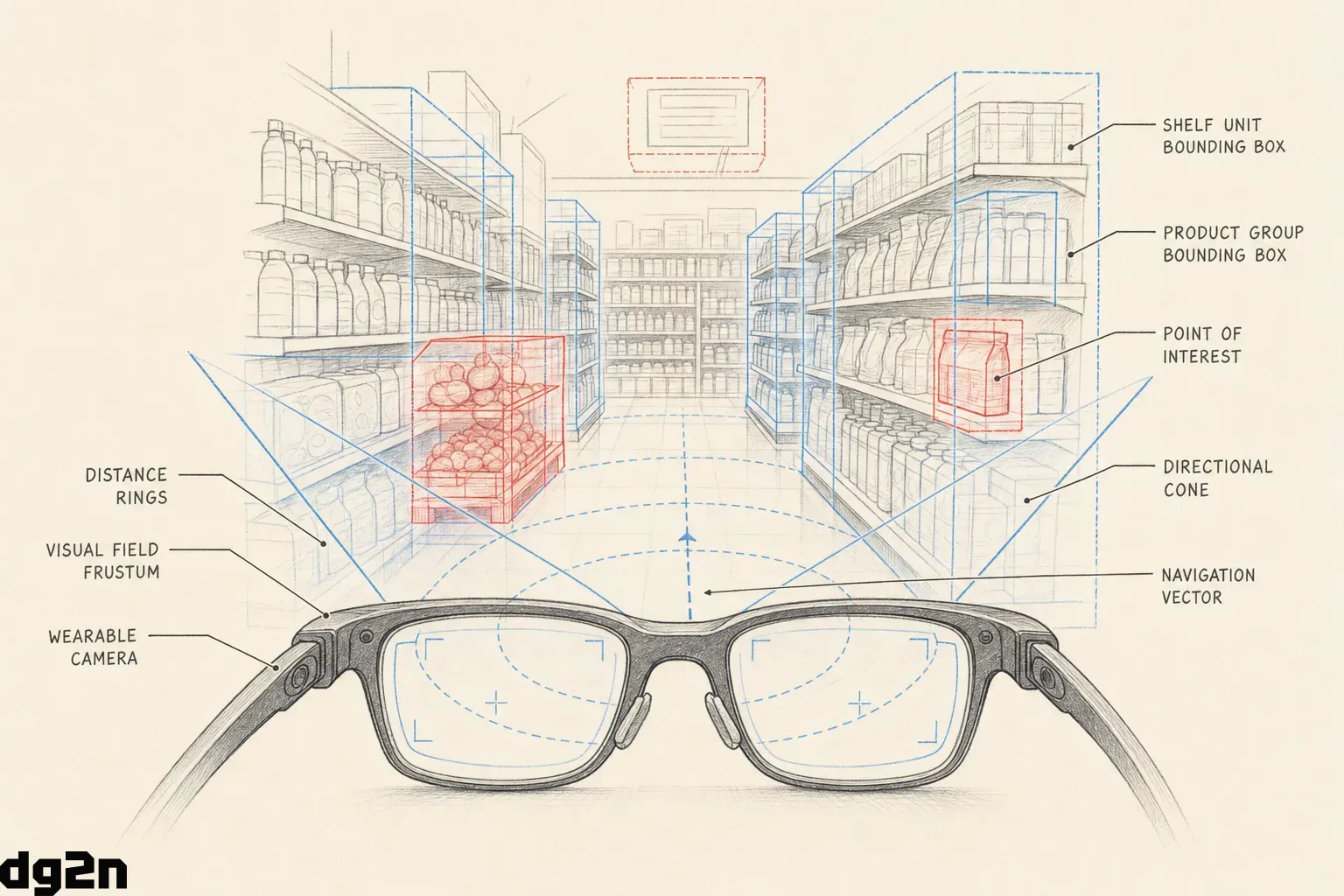
In Ballarat, Australia, a woman who has been legally blind since 22 now shops at Kmart on her own. She asks her Meta glasses where she is, and the answer comes back in her ear: she seems to be in the women's section, the register is to her left, the entrance is behind her. After sixteen years of needing a guide dog to get groceries, she says she would not get another one.
Read that answer again. "Seems to be." The model is reconstructing the store from whatever the camera catches in that second: a sign, a rack, the shape of a counter. It has no plan of the building, no fixture list, no idea that the seasonal bay moved on Tuesday. The hedge is the most honest part of the system.
Guide Dogs Victoria's position is that glasses should never be anyone's primary mobility aid, and on today's technology that is right. The glasses work well enough to change a life and badly enough that a cane is still mandatory. The gap between those two facts is a mapping problem, and the store is the only party that holds the map.
Synthetic shoppers walk a store someone drew
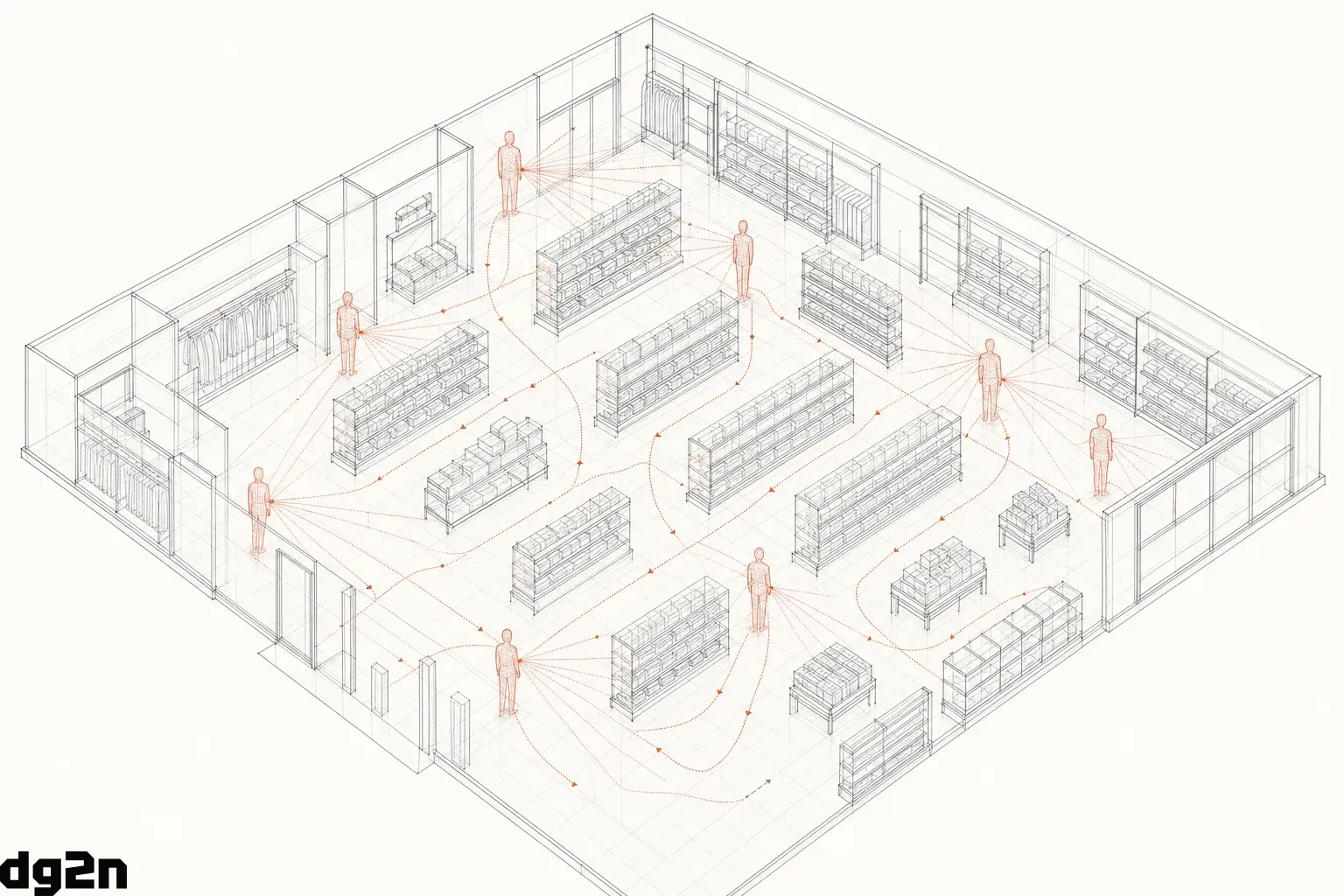
On the other side of the planning cycle, Korea's CU is running the same experiment in reverse. BGF Retail, which operates the chain, has partnered with a local AI startup to generate synthetic consumers: populations of AI-built shoppers that answer surveys, react to price points and, in the next phase, walk through virtual replicas of real CU stores. The stated goal is to test displays, customer flow and fixture arrangements before a franchisee moves a single shelf. A proof of concept on boxed meals has been running since May.
The appeal is obvious to anyone who has signed off a reset. A layout change in a convenience format touches thousands of stores, the margin for error is thin, and the only real test today is to roll it out and watch. A simulation promises the watching without the rolling out.
What the simulation actually runs on is two inputs: a model of the space and a model of the shopper. Synthetic shoppers get all the attention. The space gets taken for granted. Yet every path a synthetic shopper walks, every sightline to a promo end, every dwell at a chiller, is computed against geometry that somebody drew, at some point, for some other purpose.
Simulation is not evidence
I build store twins and sell simulation on top of them, so I can say plainly where it breaks.
A simulation is a very fast way to generate hypotheses. It tells you which of twenty layouts deserve a real trial. What it cannot do is tell you which layout works, because nothing inside the simulation has ever been checked against a till.
It breaks in three places, and they compound.
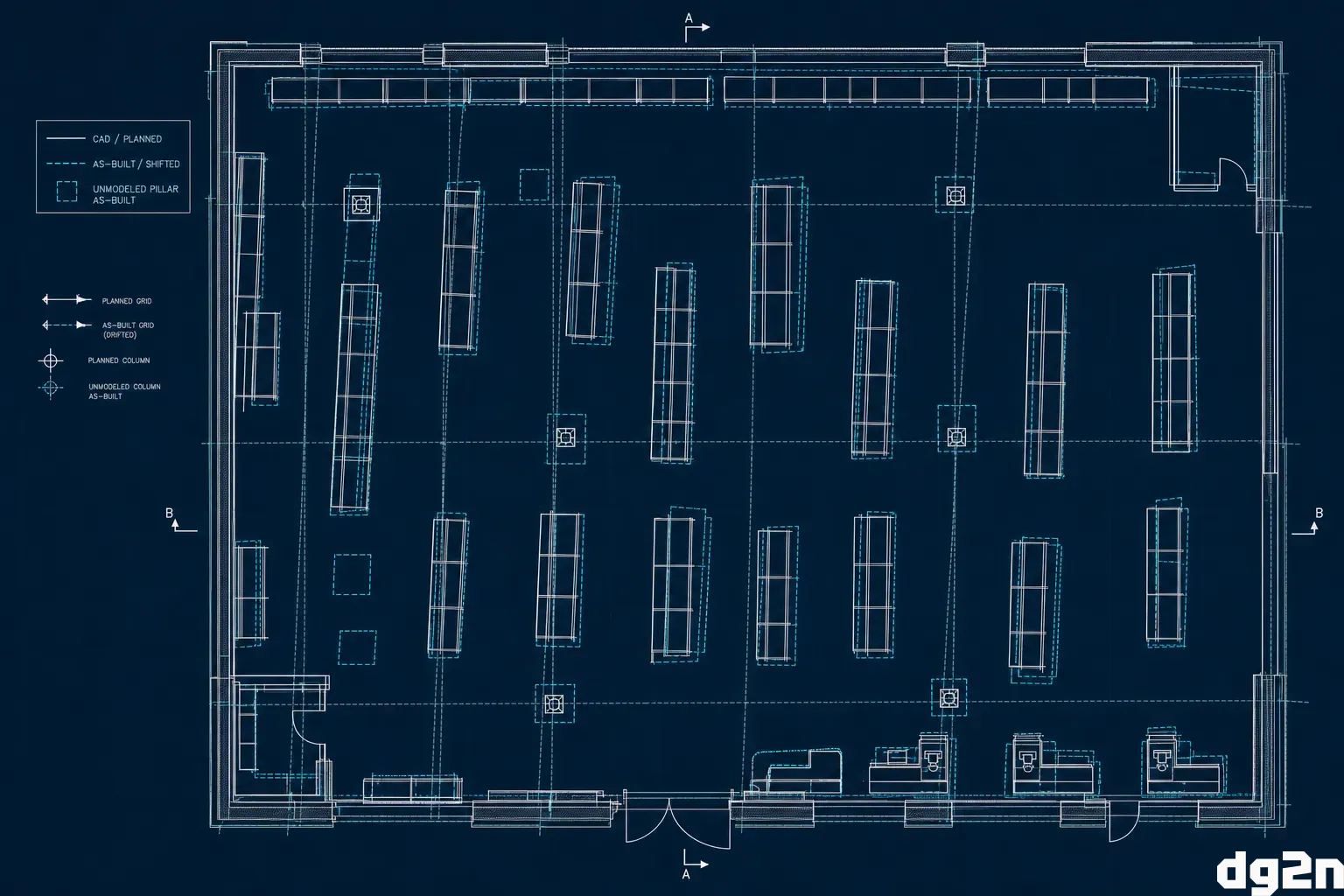
The floor drifts. Stores are re-merchandised weekly. Fixtures get swapped, a gondola end becomes a stack-out, a pillar nobody modelled blocks the line of sight to the new signage. A twin built from the opening-day CAD is a model of a store that stopped existing months ago, and the simulation inherits every one of those errors without flagging any of them.
The shopper is an average. A synthetic consumer built on a language model carries the statistical habits of its training data. It can be tuned with panel and transaction data, and the better providers do exactly that, but its default is a plausible shopper, not your shopper at 11pm on a Thursday in a residential lane.
Nothing closes the loop. The output of a simulation is a confident number: footfall past the bay, conversion at the endcap, minutes in store. Unless that number is predicted before a change and measured after it, in a real store, it is a forecast that never gets graded. A forecast that never gets graded never gets better.
Even the coverage of CU's trial says as much: simulations need constant validation against real stores. That sentence is the whole argument. Validation is the part that makes a simulation worth paying for.
Calibration is the product
A simulation earns trust the same way a demand forecast does: by being wrong in public, in numbers, and improving. In practice that needs four things in place before the first synthetic shopper walks in.
Measured geometry. Fixtures, aisles, heights and sightlines captured from the real store, to a tolerance that matters for the question being asked. A phone walk-through or a scan beats a drawing, because it records what is there rather than what was intended.
Refresh at the cadence of change. The twin has to be rebuilt as often as the floor is re-merchandised. If capture is expensive, refresh will lag, and every simulation will quietly run on last quarter's store.
Held-out stores. Predict the effect of a change before it happens, make the change in a handful of stores, measure footfall and sales by hour, and compare. Keep a set of stores the model was never tuned on.
A published error band. Every simulated result carries the gap between what the model predicted and what the stores did last time. A layout that wins by less than that gap has not won.
None of this is exotic. Hourly footfall, transaction logs and periodic capture already exist in most chains. What is usually missing is the discipline of treating the twin as measured infrastructure rather than a rendering, and the simulation as a claim that has to be checked.
The same twin answers both readers
Here the two stories meet. The glasses in Ballarat and the synthetic shoppers in Seoul are asking the store the same question: what is here, and where is it? One asks on behalf of a person standing in the aisle. The other asks on behalf of a planner deciding what the aisle should become.
A measured, refreshed twin answers both. The geometry that lets you trust a simulated sightline is the same geometry that lets a wayfinding agent say "the register is four metres ahead, past the second gondola" instead of "seems to be." For a blind shopper, that difference is the gap between a helpful companion and something she can actually rely on. For the store, it is accessibility delivered as a by-product of planning data it should be keeping anyway.
The question of who holds that layer is still open. If retailers do not publish a trustworthy model of their own floors, the glasses vendor's guess becomes the de facto map of every store its customers walk into, built from footage the store never agreed to. California's governor has just vetoed a bill that would have required a visible recording light on smart glasses from 2028, calling it too broad. So for now the cameras keep walking the aisles, and the people who own the walls have little say in what those cameras conclude.
We run planograms on twins across thousands of stores, and the lesson from that scale is unglamorous: the model is only ever as good as the last time someone measured the floor.
Both new shoppers are guessing. Only one of them admits it.