
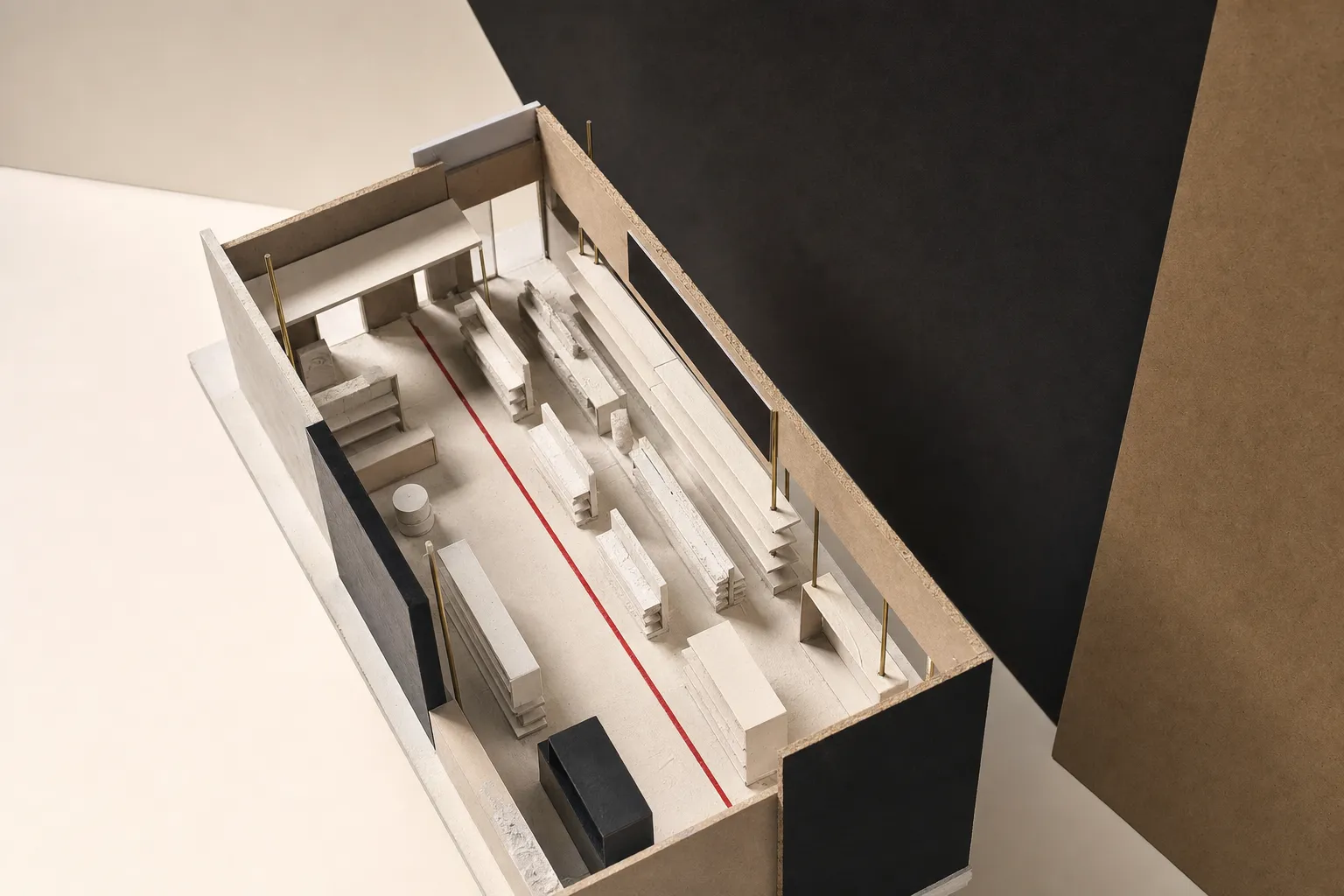

A planner is only as good as the space it searches. Change the shape of that space and the same objective moves from intractable to a handful of gradient steps, with no change to the planner at all. This is the most underrated lever in applied AI, and in physical retail it is the difference between a space planning system that runs overnight on a cluster and one that runs in a second on a laptop.
A paper from NYU this year makes the point cleanly, and it makes it in a setting where the geometry has to be learned. Which is worth understanding, because in retail it does not.
Curvature is a cost
Temporal Straightening for Latent Planning (Wang, Bounou, Zhou, Balestriero, Rudner, LeCun and Ren, ICML 2026) starts from the standard recipe for latent planning. A world model compresses observations into a compact latent state, learns the dynamics in that latent space, and plans by rolling the model forward and minimising a cost between the predicted state and the goal. Working in the latent abstraction rather than in pixels reduces dimensionality and throws away noise, which is exactly why the recipe is attractive.
The trouble starts with the encoder. The obvious move is to use a strong pretrained visual encoder, which gives you semantically rich features for free. But those features were optimised for recognition, not for planning, and they carry a great deal that planning does not need and some that planning is actively hurt by. Encode a trajectory with one and the resulting latent path comes out highly curved.
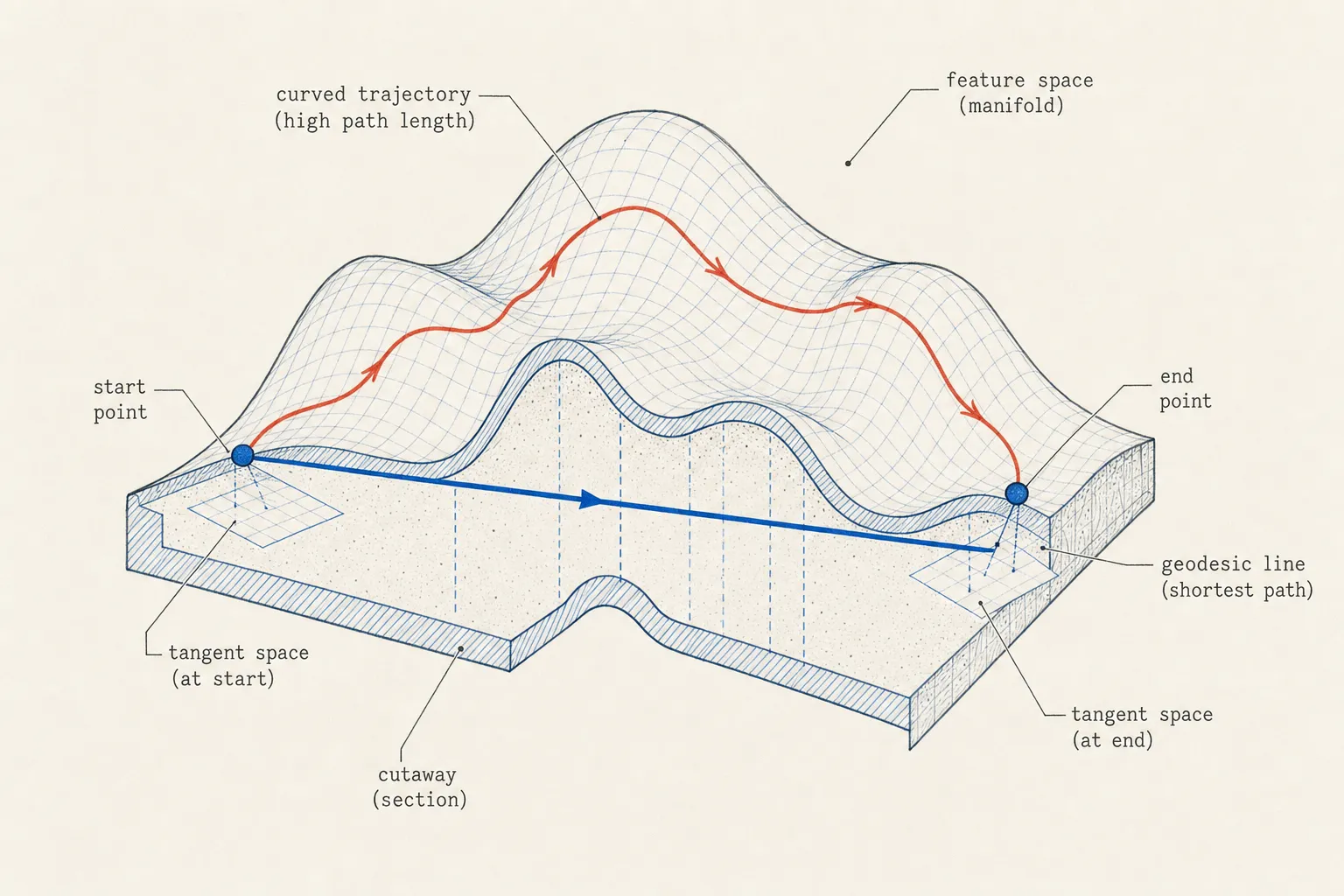
Curvature has a specific and expensive consequence. When the path through the embedding bends, straight-line distance in that embedding stops standing in for the real distance along feasible transitions. Euclidean distance and geodesic distance come apart. A cost function built on the former is now measuring something that is not progress toward the goal, the optimisation surface becomes badly conditioned and non-convex, and gradient-based planning stalls. The field's workaround has been to stop using gradients and start sampling: CEM, MPPI, and the rest of the search-based family. They are competitive, and they are slow. The compute burden and the latency are the tax you pay for a representation whose metric does not mean anything.
The authors do not pay it. Instead of building a planner that tolerates the curvature, they remove the curvature so an ordinary planner works. They define a latent velocity between consecutive states and add a regulariser that pushes consecutive velocities to point the same way, minimising the negative cosine similarity between them, and they train the encoder and the predictor jointly inside a JEPA world model rather than freezing a pretrained backbone. The inspiration is the perceptual straightening hypothesis in human vision, which holds that biological visual systems transform complex natural video into straighter internal representations.
The result is the one they were after. Trajectories come out measurably straighter, Euclidean distance in the latent space starts tracking geodesic distance, the planning objective conditions well, and plain gradient-based planning becomes stable with significantly higher success rates across goal-reaching tasks. They also find that the JEPA prediction objective induces some straightening on its own, since representations that are easy to predict tend to be smooth, and that the explicit regulariser strengthens and stabilises the effect.
The property that actually matters
Strip out the machinery and a general principle is left standing.
A representation is ready for planning when distance inside it corresponds to effort in the world. That is the whole requirement. Semantic richness is a different property, it is not sufficient for this one, and past a point it competes with it. A great deal of work in learned world models is, in effect, an attempt to buy this property back after choosing an encoder that did not have it.
Which raises a question worth asking before you start training anything. Does your domain hand you a metric already?
Physical space arrives straight
In physical retail, it does.
A store has a real metric and it is not a learned one. A 780mm aisle. A 1.6m reach height. A 62mm facing. A shelf with 340mm of clear vertical space. Distance in millimetres is effort: it is walking, it is reaching, it is whether the carton physically goes in. There is no gap between the embedding's notion of distance and the world's notion of distance, because the embedding is the world's dimensions. In a retail digital twin the straightening step is not a regulariser. It is a tape measure.
This is the argument for representing a store as a store. The moment a store is flattened into a photograph, the metric is gone. A shelf image is a projection, and projection discards exactly the quantity that planning depends on. Everything downstream is then an attempt to infer back what the camera threw away, using model capacity that could have been spent on the actual merchandising question.
What a well-conditioned store buys
The payoff shows up as smaller solvers.
Legacy space planning runs heavy combinatorial search over constraint sets, and it does so for the same reason the latent planning literature reaches for CEM and MPPI. When the representation carries no reliable notion of distance, every candidate arrangement has to be enumerated and scored, because there is no gradient to follow. The search is compensating for the representation.
Give the objective real geometry and the picture inverts. Fit becomes arithmetic rather than a hypothesis to be tested. Adjacency becomes a distance in a space where distance is meaningful. Reachability, blocking and vertical break become computations against known dimensions. What is left for the solver is the genuinely hard part, which is the merchandising judgement, and that part is small enough to be specialised. One tractable solver per category beats one enormous search over everything, and it only becomes possible once the geometry stops fighting you.
The metric has to be earned
The catch is that a store only arrives straight if you actually go and measure it. Real dimensions are cheap in principle and expensive in practice, and this is where most of the engineering lives.
SKU geometry has to be metric and it has to be capturable by store staff rather than by a lab. CALIPER dimensions a product to roughly a centimetre from two phone photographs taken against a printed A4 ChArUco sheet, through a deterministic CPU pipeline with no learned segmentation in the loop, and binds the result to a GTIN.
Fixture geometry has to come from the store as it is, not from the drawing of the store as it was meant to be. That is a reconstruction problem, solved by walking the aisle with a phone and lifting the video to 3D.
Demand has to be structured rather than narrated, which is what scoring rubrics like STYLE for fashion and VARS for grocery exist to do.
And all of it has to land in one shared schema, so that perception, computation and merchandising reasoning read the same substrate instead of three private ones that disagree at the seams. That is the role OpenShelf plays.
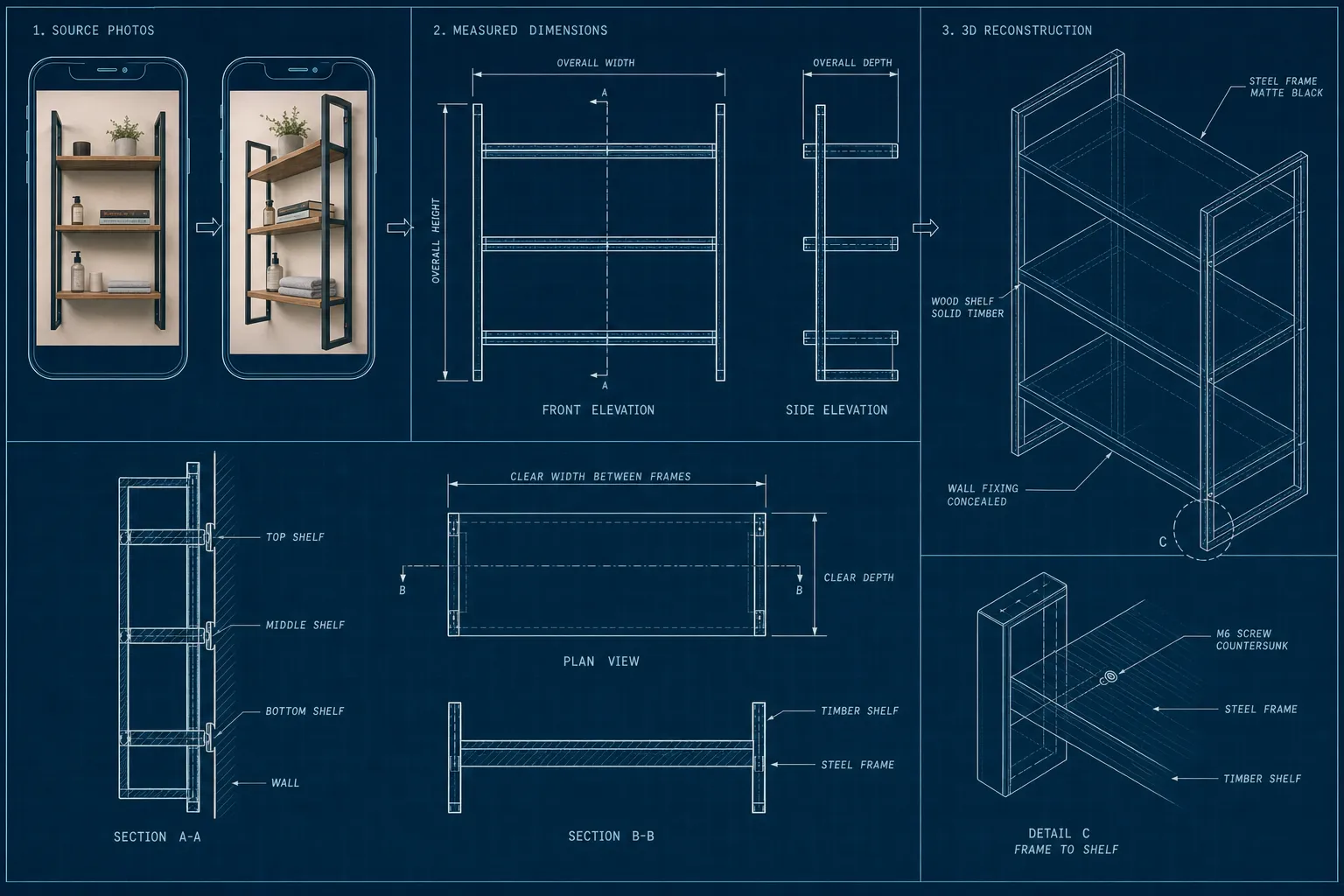
None of these are glamorous. Collectively they are the thing that makes the solver small.
Measure, then plan
The lab is going to considerable effort to learn embedding spaces in which distance means something, because in a simulated goal-reaching task there is no ruler to appeal to and the geometry has to be induced from data. It is real work and the ICML paper does it well.
Stores are not latent. The ruler exists. The strategic mistake available to retail AI is to spend the next five years learning to recover, from imagery, a metric that could simply have been captured, and to pay for the omission forever in solver compute.
dg2n has taken the other route. StoreGen now runs in production across roughly 3,000 stores, generating layouts and planograms against measured fixtures and dimensioned products rather than against inferred ones. The systems are modest in size because the representation does the heavy lifting. That is not a coincidence, and it is not an implementation detail. It is the same finding the straightening paper arrives at from the opposite direction: fix the geometry first and the planning gets easy.
References & Notes
- Temporal Straightening for Latent Planning. Wang, Bounou, Zhou, Balestriero, Rudner, LeCun, Ren. ICML 2026, PMLR 306.